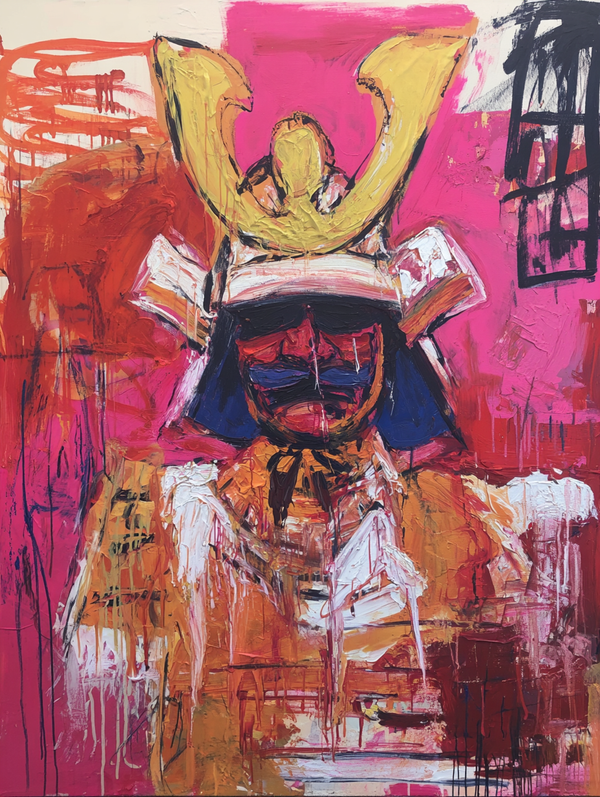
In the battles of the Sengoku period, banners were not decorative. They were visible commands — instructions to thousands of soldiers delivered across the chaos of a battlefield in an instant. A banner had to communicate something essential, something a soldier could grasp in a heartbeat and carry into the fight.
Takeda Shingen chose four characters for his. They read: 風林火山 — Fūrinkazan. Swift as wind. Silent as forest. Fierce as fire. Immovable as mountain.
The phrase comes from Sun Tzu's The Art of War, written in China roughly two thousand years before Shingen was born. That a Japanese warlord of the 1500s would carry ancient Chinese philosophy into battle tells you something immediately: Shingen was not merely a fighter. He was a thinker — a man who understood that how you move, when you stop, and what you become are all military questions, and all human questions, at the same time.
This article follows two threads simultaneously: the life of Takeda Shingen, one of the most formidable warlords of his age, and the meaning of the four principles he carried — and what they reveal when placed alongside the Bushido code.
The warlord of Kai: who Shingen actually was
Born in 1521 as the eldest son of the Takeda clan in Kai Province (modern Yamanashi Prefecture), Shingen came into his lordship through an act that defined him for life — and has colored his reputation ever since. At the age of 21, he expelled his own father from the domain in a coup, assuming control himself.
To Western eyes this reads as simple betrayal. In the Sengoku context, where clan survival depended on clear-headed leadership, it was closer to a calculated necessity — his father's erratic governance was threatening the clan's stability. But Shingen never fully escaped the shadow of it. His younger brother Nobushige, who might have led a rebellion, chose loyalty instead. Shingen repaid that loyalty for the rest of his career, making Nobushige one of his most trusted generals.
The man behind the warlord
Shingen governed Kai Province with a sophistication unusual for his era. He constructed flood-control embankments along the Kamanashi and Fuji rivers — engineering projects so well-built that remnants are still visible today. He implemented early land surveys and tax systems that stabilized his domain's economy. His retainer band, held together by a system of mutual obligation and genuine personal loyalty, was regarded by contemporaries as one of the most cohesive fighting forces in Japan.
He also suffered from chronic illness — likely tuberculosis — for much of his later life, campaigning while managing severe physical decline. The disease that would eventually kill him never stopped him from commanding in the field.
----
Shingen was not the romantic hero of later legend — he was something more interesting: a pragmatic, deeply intelligent administrator who also happened to be one of the most dangerous men on a battlefield in sixteenth-century Japan. And the philosophy on his banner was a faithful map of how he thought.
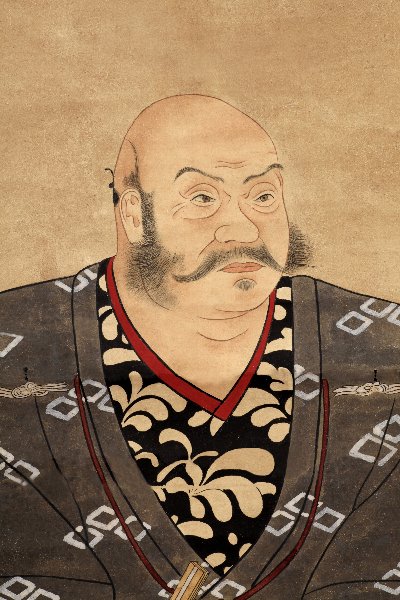
A life of battles — and one unfinished ambition
1521 · Born in Kai Province
1541 · The coup
1553–1564 · The Kawanakajima campaigns
1572 · The western campaign begins
1573 · Death in the field
Fūrinkazan: the four principles, and what they really mean
Shingen's banner was a direct quotation from Chapter Seven of Sun Tzu's The Art of War — a text on military strategy that is, at its core, a text about the disciplined use of mind, timing, and force. Each of the four characters describes a quality of movement. Together, they describe something more complete: a map of when to act and when not to — and what kind of person can make that judgment reliably.
風 / Fū · Wind
"Swift as the wind"
林 / Rin · Forest
"Silent as the forest"
火 / Ka · Fire
"Fierce as fire"
山 / Zan · Mountain
"Immovable as a mountain"
Fūrinkazan and Bushido: a direct comparison
Sun Tzu wrote for commanders. Bushido was written — over centuries, through accumulated practice and eventually through texts like Nitobe Inazo's Bushido: The Soul of Japan — for individuals. The question is whether these two frameworks, separated by culture and century, are actually describing the same thing from different angles.
The comparison reveals something striking: they are not identical, but they are deeply compatible. Where Sun Tzu asks "how should you move?", Bushido asks "who must you be in order to move that way?" One is strategic. The other is ethical. Together, they form something more complete than either alone.
| Principle | Fūrinkazan (Sun Tzu) | Bushido virtue |
| Wind 風 | Act with decisive speed when the moment demands. Hesitation is the same as defeat. | Yu 勇 — Courage. The capacity to act without being paralyzed by doubt or fear. Speed comes from having already resolved the question of what you stand for. |
| Forest 林 | When still, be completely still. Noise without purpose reveals your position and exhausts your strength. | Makoto 誠 — Sincerity and inner integrity. A person who is truthful with themselves has no need to perform. The forest does not advertise its depth. |
| Fire 火 | When committed, commit completely. Attack that is held back fails doubly — it neither succeeds nor preserves. | Gi 義 — Righteousness. Once you have decided what is right, do it fully. Moral half-measures — like tactical ones — satisfy no one and accomplish nothing. |
| Mountain 山 | In defense, be genuinely immovable — not through stubbornness but through depth. A mountain cannot be argued or panicked into moving. | Jin 仁 · Rei 礼 — Benevolence and respect. The deepest virtues are the most stable. A person grounded in genuine care for others and genuine respect for the world is not easily shaken by circumstances. |
Sun Tzu describes how to move. Bushido describes who must do the moving. Fūrinkazan tells you that sometimes you must be wind and sometimes you must be mountain — but it cannot tell you how to know which moment you are in. That judgment requires exactly what Bushido cultivates: a self that is clear, honest, courageous, and grounded enough to read a situation without distortion. The two frameworks are not rivals. They are layers of the same thing.
How Shingen himself embodied — and fell short of — his own banner
What makes Shingen particularly interesting as a subject is that his life provides both positive and negative illustrations of the principles on his banner — often in the same campaign.
Wind in action — the response to Honnō-ji's ripple
The Battle of Mikatagahara in 1572 is a textbook example of Fū — wind. Shingen moved his forces with such unexpected speed and from such an unexpected direction that Tokugawa Ieyasu was drawn into a battle he had not planned to fight, on ground he had not chosen. Ieyasu barely escaped with his life. Shingen had read the tempo of the situation perfectly and acted before his enemy could establish a defensive rhythm.
Mountain in failure — the western campaign's fatal patience
Yet in the same western campaign that produced his greatest tactical victory, Shingen moved with the slowness of a man who believed he had more time than he did. After Mikatagahara, with the path to Kyoto apparently open, his advance slowed — whether from illness, logistics, or strategic caution. He never reached Kyoto. He died en route, the campaign incomplete. The mountain had become, perhaps, too immovable at precisely the moment that wind was needed. History does not grant second campaigns.
This tension — between the mountain's stability and the wind's urgency — is not a failure of the philosophy. It is the philosophy's deepest challenge: knowing which of the four you must be, right now, in this moment. Shingen came closer to answering that question than almost any commander of his age. The fact that he could not always answer it correctly is what makes him human — and what makes his story worth studying.
A man who has attained mastery of an art reveals it in his every action. Samurai have no need to be pompous. It is sufficient to be strong.
— Attributed to Takeda Shingen
What Fūrinkazan teaches that Bushido completes
Reading Fūrinkazan and Bushido together, a picture emerges of what a complete person — not just a complete warrior — might look like.
Wind without courage is just movement. Courage is what makes speed purposeful rather than reckless — the willingness to commit before certainty arrives, because waiting for certainty is itself a decision.
Forest without sincerity is just silence. The warrior who is still because they are genuinely composed is different from the warrior who is still because they are afraid to act. Sincerity is what makes stillness powerful rather than passive.
Fire without righteousness is just destruction. The most devastating campaigns in history — military and otherwise — have been fires with no moral compass. What Bushido adds to Sun Tzu's fire principle is a question: In whose service does this fire burn? Fire directed by gi creates; fire without it only consumes.
Mountain without benevolence is just obstinacy. The leader who is immovable because they are genuinely grounded in care for their people is fundamentally different from the leader who is immovable because their ego cannot accept change. Jin — benevolence — is what turns stubbornness into stability.
The banner, the man, and what endures
Takeda Shingen died without reaching Kyoto, without unifying Japan, without achieving the supreme ambition of his final years. His clan collapsed within a decade of his death. By the measures that Sengoku warlords used to count success, he fell short.
And yet the four characters on his banner have outlasted every warlord who did succeed. They are still quoted in Japanese business strategy, military education, and leadership writing. They appear on modern sports banners, corporate mottos, and martial arts dojos. Shingen's philosophy proved more durable than his dynasty.
Perhaps because Fūrinkazan was never only about war. It was about the recurring human challenge of knowing when to move and when to wait, when to commit fully and when to hold your ground — and about becoming the kind of person whose judgment in those moments can be trusted.
Bushido asks the same question from the inside out: not "what is the right move?" but "who must I become in order to reliably know the right move?" Four characters on a battle banner. Seven virtues on a warrior's code. The same territory, mapped from different directions — and between them, something close to a complete answer.