The question this article starts with
If you've ever encountered the concept of seppuku — the ritual self-ending practiced by Japanese samurai — your first reaction was probably some version of: "I don't understand how anyone could do that."
That reaction is completely understandable. Viewed through a modern Western lens, the act seems incomprehensible at best, and deeply disturbing at worst. It is the single aspect of samurai culture that most reliably stops Western readers cold.
But here is the thing about that reaction: it tells us less about seppuku than it does about the enormous distance between two value systems — one built around the preservation of life as the highest priority, and another built around something else entirely. Understanding seppuku means crossing that distance. And once you do, something unexpected happens: it starts to make a profound kind of sense.
First: what it actually was — and wasn't
Much of what Western popular culture believes about seppuku is wrong, or at least incomplete. Before we can understand what it meant, we need to clear away the misconceptions.
Common misconception
What it actually was
Common misconception
What it actually was
Common misconception
What it actually was
The value at the center: meiyo
To understand seppuku, you have to understand what samurai culture considered the most precious thing a person could possess. It was not wealth, not power, not even life itself. It was meiyo — honor, or more precisely, the integrity of one's name and reputation.
In the Bushido framework, a person's honor was not merely a feeling or a social nicety. It was the accumulated weight of every promise kept, every duty fulfilled, every moment of courage and integrity across an entire lifetime. It was, in a very real sense, the measure of whether your life had meaning.
And it could be lost. Irreversibly, publicly, permanently. A samurai who betrayed his lord, who fled from battle out of cowardice, who was caught in a serious act of dishonesty — that samurai's name was, by the standards of his culture, ruined. Not just for him. For his family. For his descendants.
Bushido perspective: Shame as a greater threat than death
Nitobe Inazo, who wrote the foundational text Bushido: The Soul of Japan in 1900, described the samurai relationship with shame this way: death was a fact of the physical world, and therefore ultimately outside a warrior's control. Shame — the destruction of one's honor — was a moral catastrophe, and therefore the one thing that could genuinely be controlled. To the samurai mind, a life lived in irredeemable disgrace was not merely unpleasant. It was a kind of failure at the deepest possible level of what it meant to be human.
----
The 47 Ronin: the case that defines everything
No single story illustrates the seppuku tradition — and the values behind it — more completely than the tale of the 47 Ronin. It is Japan's most celebrated moral drama, and it has remained so for over three centuries.
Historical episode · 1701–1703
In 1701, a feudal lord named Asano Naganori was provoked into drawing his sword inside Edo Castle — a serious breach of protocol — by a court official named Kira Yoshinaka, who had allegedly insulted and humiliated him over a period of months. For this act, Asano was ordered to perform seppuku that same day. His estate was dissolved. His samurai became ronin — masterless warriors with no lord to serve.
Forty-seven of those ronin refused to accept this outcome. They spent nearly two years in patient, covert preparation. They dispersed, took on civilian disguises, and allowed themselves to be publicly humiliated so that Kira would lower his guard. Then, on a winter night in December 1702, they gathered, stormed Kira's compound, and carried out their lord's vengeance.
They then turned themselves in to the authorities and requested the right to perform seppuku rather than be executed as criminals. After considerable debate — because their act was simultaneously illegal and widely seen as deeply honorable — the request was granted. All 47 performed seppuku in February 1703 and were buried alongside their lord.
----
The story electrified Japanese society. Plays were written about it within weeks. It has been retold in every generation since, in every medium from kabuki to film. Why? Because it captures something that the Japanese cultural imagination finds deeply meaningful: loyalty that costs everything, fulfilled completely.
The ronin's seppuku was not defeat. It was the final act of a mission accomplished. They had restored their lord's honor, and then they chose to follow him — on their own terms, with dignity intact.
Bushido perspective: Responsibility that extends beyond the self
One aspect of seppuku that Western readers often miss is its relational dimension. The samurai did not think of honor as purely personal — it belonged to his lord, his family, his retainers, and the relationships he held. When he failed in a way that damaged those relationships, seppuku was, in part, an act of accountability toward others. It was saying: I will not make the people connected to me carry the weight of my disgrace. I will resolve it myself. In this light, it was less an act of self-destruction than an act of extraordinary consideration for others — taken to its most extreme possible conclusion.
The ritual and what it communicated
The formal ceremony of seppuku had a specific structure — one designed to communicate composure, intentionality, and dignity at every stage. Each element carried meaning.
1: The death poem (jisei-no-ku / 辞世の句)
2: Ritual clothing and setting
3: The act itself and the kaishakunin
4: Composure as the final measure
The way of the samurai is found in death. Meditation on inevitable death should be performed daily. Every day, when one's body and mind are at peace, one should meditate upon being ripped apart by arrows, guns, spears, and swords.
— Yamamoto Tsunetomo, Hagakure, 1716
This famous passage from the Hagakure is often read as morbid or fatalistic. But its actual intent is the opposite: by accepting death fully and completely, the samurai was freed from the fear of it — and therefore free to act with total integrity, at all times, without hesitation.
Is this so different from what other cultures value?
Before dismissing seppuku as uniquely alien, it is worth pausing on a question: are the values underneath it really so unfamiliar?
Ancient Rome : Death before dishonor
Medieval Europe : The knight's code
Modern context : Accountability as virtue
Universal human theme : The weight of a name
What this means beyond its historical context
Seppuku as a practice belongs to a specific historical world that no longer exists — and nothing in this article should be read as a suggestion that its logic applies to the present. It doesn't, and Bushido scholars are careful to make that distinction.
But the values underneath it are very much alive. The idea that how you face failure matters as much as the failure itself. That accountability is not just a legal concept but a moral one. That your name — your integrity, your reputation for keeping your word — is worth protecting at real cost to yourself.
These are not ancient Japanese ideas. They are human ideas, expressed through an ancient Japanese form. And when you understand seppuku that way — not as a shocking curiosity, but as the most extreme expression of values that most people quietly share — it stops being incomprehensible. It becomes, in its own way, a mirror.
If this resonated with you
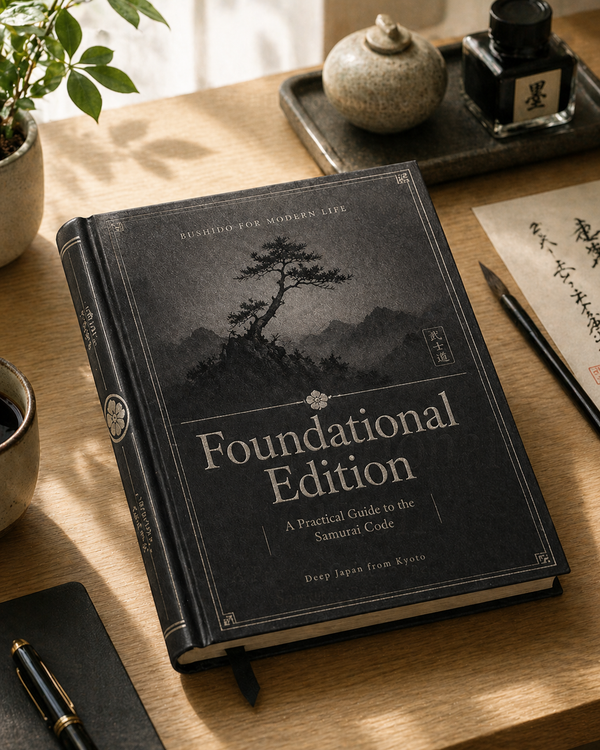
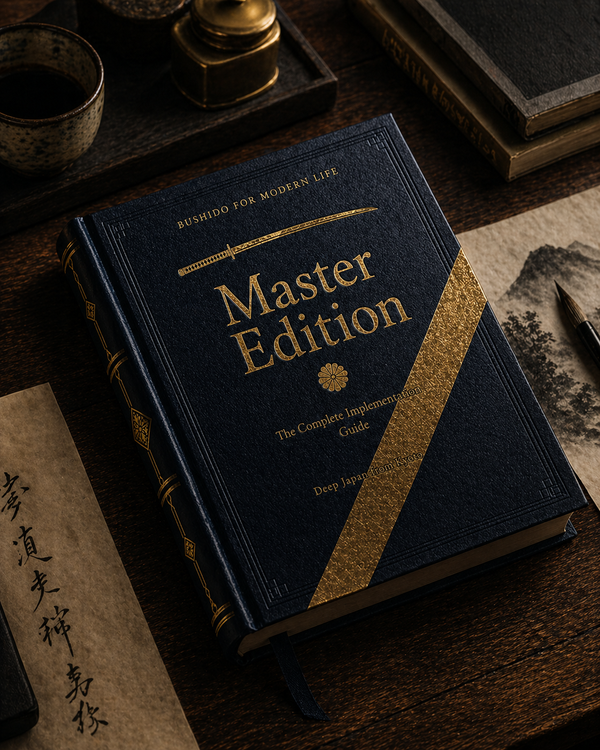
We've put together an e-book that traces the Bushido code through stories like this one — connecting the lives of Japan's most iconic samurai to timeless principles you can actually use. It reads less like a history lesson and more like a conversation across centuries.
Bushido for Modern Life(Complete Edition)| The Full Two-Book System — Framework + Implementation