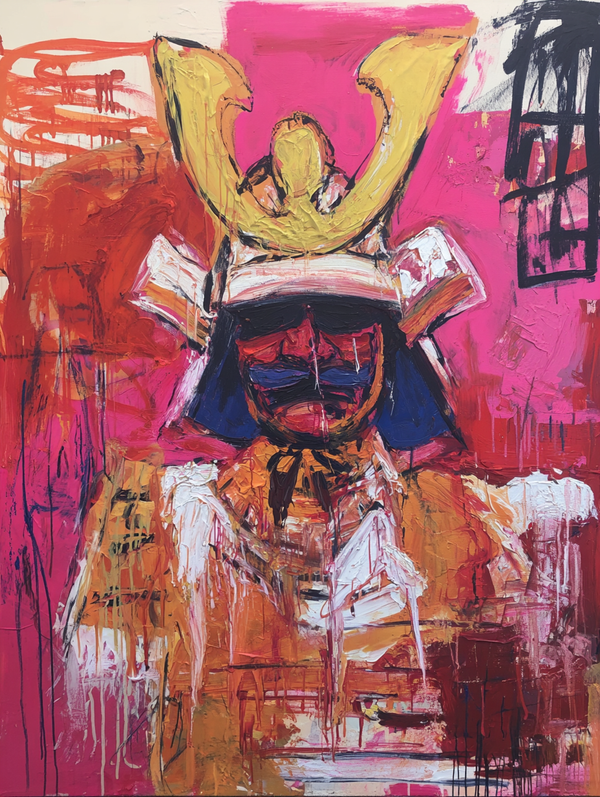
When Loyalty Has No Single Lord
Most explanations of Bushido begin in the same place: the relationship between a samurai and his lord. The retainer serves. The lord commands. Loyalty flows upward through a clear hierarchy, and the warrior's honor is measured by how completely he maintains that vertical bond.
The Matsuura Party — Matsuura-tō, the confederation of sea clans that dominated the waters off Nagasaki Prefecture from the 11th century onward — challenges this picture in ways that are genuinely instructive.
Here was a warrior society that had no single commanding lord, no strict vertical hierarchy, and no central authority strong enough to impose discipline from above. What held them together was something older, more lateral, and in many ways more demanding: the bond of blood, shared territory, and collective identity. They called themselves a tō — a party, a league, an alliance — rather than a domain or a retainer band. The distinction matters.
Understanding what made the Matsuura Party cohere, endure, and fight is understanding a dimension of Bushido that the standard accounts tend to underemphasize.

Origins: A Dynasty Rooted in the Sea
The origins of the Matsuura Party trace back to the Saga Genji — the imperial line descending from Emperor Saga through his son Prince Minamoto no Sadamu. The specific lineage most associated with the party's founding runs through Watanabe no Tsuna, a warrior of the late Heian period, to his descendant Matsuura Hisashi, who came to the Matsuura district of Hizen Province (present-day Nagasaki Prefecture) and became the administrator of the Uno御厨 estate in 1069, during the first year of the Enkyū era.
Hisashi took the name of the land he governed — Matsuura — as his own surname, as was common practice in this period. His descendants did the same, each branch of the family adopting the name of its particular territory. Over generations, this produced dozens of distinct clans — the "forty-eight parties" of the confederation's name — each rooted in a specific place along the archipelago-studded coastline of northwestern Kyushu.
Historical scholarship complicates this founding narrative in interesting ways. Documents suggest that figures with the naming conventions of the Saga Genji lineage were active in this region before Hisashi's arrival in 1069. The Shōyūki — the diary of Fujiwara no Sanesuke — records that in 1016, a figure named Minamoto no Kiku was appointed Governor of Hizen and paid a formal visit of greeting. Three years later, in 1019, during the Toi Invasion — a raid by continental forces from the Korean peninsula — a former assistant governor of Hizen named Minamoto no Shirasu commanded the defense, personally killing many of the raiders and capturing one alive. These figures appear to have been the progenitors of what would become the Matsuura lineage, already establishing the pattern of sea-based defense that would define the party for centuries.

Structure: A League, Not a Domain
The organizational structure of the Matsuura Party is what makes it distinctive — and what makes it a particularly interesting lens for examining Bushido.
Each clan within the confederation took the name of its home territory. The connection among them was kinship — real or acknowledged — rather than feudal obligation. There was no single overlord with the authority to command all branches. Instead, the confederation operated through alliance: clans with demonstrated leadership ability and military strength emerged as sōryō — the senior or leading house — while maintaining the nominal equality of the party's lateral structure.
In the words of historical accounts of the period, this was a tō-teki ketsu-gōtai — a "party-type unified body" — in which the binding force was not the vertical authority of a lord but the horizontal solidarity of kinship and shared interest. The analogy to a modern alliance of independent states is imperfect but useful: member clans maintained their autonomy, contributed to collective defense and enterprise, and recognized the leadership of the strongest among them without surrendering independence to it.
This structure placed unusual demands on the bonds that held the confederation together. Without a lord who could compel loyalty through the threat of punishment or the promise of reward, the Matsuura clans had to find cohesion elsewhere. They found it in something that Bushido would recognize immediately: shared identity, shared honor, and the bonds of kinship that made each clan's reputation inseparable from the confederation's collective standing.
The Sea as Their Domain: Military Power and International Reach
The Matsuura Party's power rested on the sea. Their territory — the archipelago-scattered coastline of what is now Nagasaki Prefecture, facing the Korean peninsula and the Chinese continent across relatively narrow waters — was not hospitable to agricultural wealth but was extraordinarily well positioned for maritime activity of every kind.
They became one of Japan's three great naval forces, alongside the Murakami Navy of the Seto Inland Sea and the Kuki Navy of the Kii Peninsula. Their ships were present at the Battle of Dan-no-ura in 1185, where they fought on the Taira side in the decisive naval engagement of the Genpei War. Their warriors were among those who faced the Mongol invasions of 1274 and 1281 — the Bun'ei and Kōan campaigns — in the waters off Takashima, close to their home territory, where the combination of Japanese resistance and catastrophic storms destroyed the continental fleet.
Their international reach was extensive and morally complicated. The same geographic position that made them effective defenders against continental invasion also made them natural participants in trade with Korea and Ming China — and, at times, in the raids and piracy that the term wakō describes. Fujiwara no Teika, the great poet and diarist, called them "the violent parties of Kyushu — those who call themselves the Matsuura Party" in his Meigetsuki diary. The Matsuura clans themselves did not use the term Matsuura-tō as a self-description — it was applied from outside, sometimes as a label of distinction, sometimes as one of condemnation.
By the Sengoku period, the Hirado Matsuura clan had emerged as the dominant force within the confederation, evolving into a proper daimyō house. Under their patronage, Hirado became a center of international commerce — the "western capital," as it was known — receiving Portuguese and later Dutch ships as Japan's window to the wider world.

Chugi(忠義)Without a Lord: The Hardest Form of Loyalty
Here is where the Matsuura Party offers its most challenging lesson for the modern understanding of Bushido.
Chugi(忠義)— loyalty — is typically understood in the context of the lord-retainer relationship. The samurai serves the lord. The lord provides land, protection, and legitimacy. The loyalty is real, but it operates within a structure that supports and rewards it.
The Matsuura clans had no such structure. Their loyalty was to something more diffuse and, in some ways, more demanding: to the confederation itself, to the kinship network, to the collective honor of a party whose reputation was built over centuries and maintained by the cumulative conduct of dozens of independent clans acting without central direction.
This is Chugi(忠義)in its most demanding form — the loyalty that has no lord to compel it, no hierarchy to enforce it, and no external reward structure to sustain it. It is maintained entirely by the internal commitment of each member to the collective identity they share.
Bushido's account of Chugi(忠義)includes what the text of this book describes as "the question that must remain alive inside any genuine loyalty": does this still deserve what I am giving it? The Matsuura clans, operating without a single lord who could answer that question for them, had to answer it themselves — clan by clan, generation by generation. The confederation's endurance across four centuries suggests that, more often than not, they found the answer was yes.
Gi(義)on the Open Sea: The Standard Under Pressure
The moral complexity of the Matsuura Party's history — the same clans who defended Japan against the Mongol invasion also conducted raids on the Korean peninsula; the same maritime networks that carried trade goods carried armed men — raises the question of how Gi(義)functions in conditions of genuine moral ambiguity.
Gi(義)in Bushido is the internal standard established before pressure arrives. It is the line that holds when convenience presses against it. Applied to the Matsuura Party, this means asking: what standard governed their choices when the options available to them included both honorable defense and predatory raiding?
The historical record suggests that the answer varied by circumstance, clan, and era — as it does for any complex human community across four centuries. What the Matsuura Party demonstrates is that Gi(義)is not a guarantee of consistent virtue. It is a practice, requiring renewal in each generation, in each clan, in each decision. The confederation's reputation oscillated between "defenders of the homeland" and "violent parties of Kyushu" because its members were human — capable of both, and required to choose.
The modern relevance is direct. Most people and organizations operate in conditions of genuine moral complexity — where the same capabilities that make them effective can be directed toward multiple ends, not all of them honorable. Gi(義)does not resolve this complexity automatically. It provides the standard against which each choice is measured — and requires the willingness to apply that standard even when the alternatives are profitable and the pressure to compromise is real.
Jin(仁)and the Bonds That Hold a Confederation Together
What held the Matsuura Party together across four centuries without a commanding lord was not primarily military strength — though they had that — and not primarily shared economic interest — though that was real. It was something closer to what Bushido calls Jin(仁): the recognition of shared humanity, the care for the network of relationships that makes collective life possible.
Jin(仁)in the context of the Matsuura confederation operated laterally rather than vertically. It was not the benevolence of a lord toward retainers — it was the mutual recognition of kinship, the shared claim on a common ancestor and a common territory, the understanding that each clan's welfare was bound up with the confederation's collective standing.
This is the form of Jin(仁)that modern organizations most need and least cultivate. The vertical form — leadership that cares for those below — is relatively well understood, even if imperfectly practiced. The lateral form — peers who genuinely recognize their mutual dependence and act accordingly — is rarer and more fragile. The Matsuura Party sustained it for four centuries. The question for modern readers is what sustained it — and whether the same conditions can be cultivated deliberately.
The answer the historical record suggests: shared identity, shared history, and the accumulated weight of what the confederation had been through together. In Bushido's terms: the practice of Makoto(誠)— keeping the word that binds the confederation — and Meiyo(名誉)— the honor that cannot be surrendered without surrendering the claim to belong.
What the Matsuura Party Teaches Modern Readers
The Matsuura Party is not a comfortable subject for anyone who wants Bushido to deliver clean moral lessons. They were, at various points, valiant defenders, international traders, and pirates. Their confederation was lateral rather than hierarchical, sustained by kinship rather than command. Their history is the history of human beings operating in conditions of genuine complexity — and sometimes doing so admirably, and sometimes not.
This is precisely why they are worth studying.
Bushido, as this book argues throughout, is not a mythology of pure virtue. It is an ethical framework developed by and for people who handled real power in complex conditions — people who understood that strength without an internal standard becomes dangerous, and that the standard must be renewed in each generation, in each individual, in each decision.
The Matsuura Party renewed that standard imperfectly across four centuries. Their confederation endured because enough of their clans, enough of the time, maintained the bonds of Chugi(忠義)that held the alliance together — the loyalty without a lord, the cohesion without a hierarchy, the honor that was collective rather than individual.
Nana korobi ya oki. Fall seven times, rise eight.
The Matsuura clans fell — in battle, in reputation, in the complexity of their moral choices on the open sea. They rose because the confederation held, because the kinship bonds survived, because enough of them maintained the internal standard that made collective identity worth preserving.
That is the lesson the sea dynasty of Nagasaki offers to anyone trying to build something that lasts without the comfort of a single commanding authority to hold it together.
The standard has to come from within. It always has.
Bushido for Modern Life is available in two editions:
Foundational Edition($30) — The complete framework: all seven virtues explained as practical tools, three historical case studies, and the cross-cultural evidence that Bushido's principles apply across every civilization that has wrestled seriously with how strength should be used.
Master Edition($70) — The full implementation: seven complete virtue guides, a 30-day practice program, six case studies of real decisions under pressure, and a one-year plan for making these principles permanent.
Complete Edition($80) — Both books. The full arc from understanding to practice. $20 less than purchasing separately.