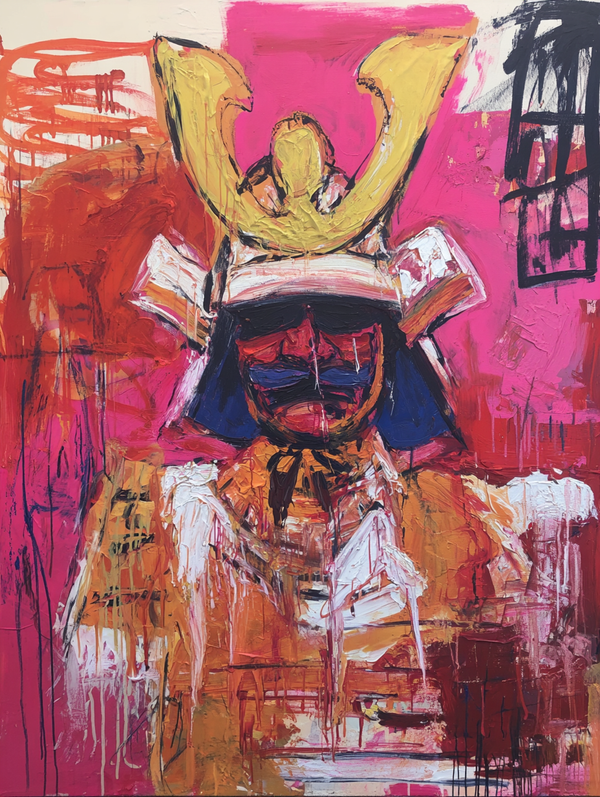
The Portrait No Conqueror Would Commission
There is a painting associated with Tokugawa Ieyasu that has become one of the most discussed images in Japanese historical culture.
The portrait — known as the Mikatagarahara Seneki Gazō, or the Battle of Mikatagahara War Portrait — depicts Ieyasu in a state that no powerful leader would typically wish to be remembered: hunched, gaunt, visibly shaken, his expression carrying something between exhaustion and despair. It is not a portrait of triumph. It is a portrait of a man who has just been thoroughly defeated.

The traditional account of the portrait's origin is compelling in its specificity. In 1572, the young Ieyasu — then an ally of Oda Nobunaga and not yet the dominant force he would become — engaged the army of Takeda Shingen at Mikatagahara. Shingen's forces were superior. The defeat was comprehensive. Ieyasu, by some accounts, fled the battlefield in a state of extreme distress. The traditional story holds that he commissioned this unflinching portrait of himself immediately afterward — as a permanent reminder of what defeat looks like, and what it costs to be unprepared.
It is a remarkable story. It is also, by the assessment of modern historical scholarship, almost certainly not true. The tradition connecting this specific portrait to this specific episode of self-imposed humiliation appears to have been constructed largely in the Showa period — the 20th century — without documentary foundation in contemporaneous sources. The portrait itself predates the tradition that explains it.
And yet: the tradition spread. It was repeated, taught, absorbed into the popular understanding of Ieyasu as a historical figure. It became, in the Japanese cultural imagination, one of the defining images of who Ieyasu was.
The question worth asking is not whether the story is historically accurate. It is why the story resonated so deeply that it became, functionally, true in the minds of so many people — and what that resonance tells us about what Bushido actually values.
What the Story Is Really About
The portrait tradition, accurate or not, encapsulates a specific and demanding ethical proposition: that a leader's primary obligation after failure is not to manage the narrative of the failure, but to confront it directly — to see it clearly, to preserve it accurately, and to carry it forward as a resource for improvement rather than an embarrassment to be minimized.
This is not the instinct that power typically produces. The instinct that power produces is the opposite: to explain the failure in ways that distribute responsibility outward, to emphasize the factors that were outside one's control, to move forward as quickly as possible toward the next opportunity for success. These responses are not irrational. They protect position, maintain morale, and allow continued functioning. But they also prevent the specific kind of learning that comes only from the unmediated encounter with what actually went wrong.
The portrait tradition suggests that Ieyasu understood something that most people in positions of power do not: that the accurate record of failure is more valuable than the comfortable narrative of it. That the face of a defeated man, preserved and visible, teaches something that the face of a triumphant man cannot. That the willingness to look at yourself in the worst moment — not to punish yourself, but to understand what happened — is a form of discipline that produces, over time, the kind of judgment that actual mastery requires.
This is Makoto(誠)operating at a level most people never reach: not the honesty of telling others the truth, but the honesty of telling yourself the truth about yourself.
Chris Paul and the Film Session
In 2024, the NBA point guard Chris Paul — at that point one of the longest-tenured and most analytically sophisticated players in professional basketball — gave an interview in which he described his approach to game film.
He was not interested, he explained, in watching his highlights. The plays where everything worked, where his reads were correct and his execution was precise — these were not particularly useful to him. He had already done those things correctly. Watching them again confirmed what he already knew.
What he watched, repeatedly and by deliberate choice, were his mistakes. The possessions where his decision-making was wrong. The defensive assignments he lost. The situations where the gap between what he intended and what he produced was most visible. These, he said, were where the information was.
The parallel to the Ieyasu portrait tradition is not incidental. Both describe the same underlying discipline: the willingness to use failure as data rather than experience it as wound, to return to the most uncomfortable record of your own performance rather than allowing it to recede into the background of a more favorable self-narrative.
In professional basketball, this discipline is sometimes called "watching film." In Bushido, it has no single name — but it is present across multiple virtues simultaneously. It is Makoto(誠)in its most demanding form: the honest self-assessment that does not flinch from what it finds. It is Kokki(克己)applied not to the suppression of impulse in the moment, but to the sustained practice of self-examination after the moment has passed. And it is, in the deepest sense, the foundation on which Meiyo(名誉)is built — not the honor that others confer on you, but the standard you hold yourself to when no one is watching, including when what you are watching is your own worst performance.
Chris Paul did not need to know the word Bushido to practice it. The discipline is older than any name for it.
Ieyasu's Actual Achievement
The historical Tokugawa Ieyasu is one of the most carefully studied figures in Japanese history, and the record that actually exists — independent of the portrait tradition — supports a portrait of a man whose primary distinguishing characteristic was patience informed by accurate self-knowledge.
Ieyasu lost at Mikatagahara in 1572. He was 30 years old. He would not become the dominant figure in Japanese politics for another 28 years — until the Battle of Sekigahara in 1600. In the intervening decades, he watched Oda Nobunaga rise, transform Japanese society, and die at Honnō-ji. He watched Toyotomi Hideyoshi consolidate power after Nobunaga's assassination and complete the project of unification that Nobunaga had begun. He waited. He maneuvered. He made alliances and survived betrayals. He lost battles and absorbed the losses.
The conventional historical assessment is that Ieyasu's greatest quality was his patience — his willingness to operate on a longer timeline than his contemporaries, to accept short-term disadvantage in exchange for long-term position, to survive.
But patience is not a passive quality. What Ieyasu demonstrated across those 28 years was not the patience of someone waiting for circumstances to improve but the patience of someone who was continuously learning from circumstances that were frequently unfavorable. The Mikatagahara defeat — whether or not the portrait tradition is accurate — was one of many situations in which Ieyasu had to assess, honestly and accurately, what had gone wrong and what the appropriate response was.
The Edo period that he founded — 260 years of relative domestic peace — was not the product of a single brilliant decision. It was the accumulated product of decades of learning, much of it extracted from failure.
Nana korobi ya oki. Fall seven times, rise eight. The Japanese proverb that runs through Bushido is not primarily about resilience. It is about the quality of the rising — whether you stand up knowing more than you did when you fell, or whether you stand up simply because standing up is what you do.
The Three Responses to Failure
When failure occurs — in a business, in a professional relationship, in a personal commitment — there are, broadly speaking, three responses available.
The first is denial: the reorganization of the facts of the failure into a narrative that assigns responsibility elsewhere, minimizes the significance of what happened, or simply declines to examine it directly. This response is emotionally comfortable and strategically costly. It preserves self-image in the short term at the expense of the learning that would prevent recurrence.
The second is self-punishment: the sustained, unproductive engagement with failure as evidence of personal inadequacy. This response feels rigorous — it is certainly not comfortable — but it produces paralysis rather than learning. The person who cannot move past their failures without extensive self-criticism is not confronting their failures honestly. They are using the appearance of honest self-examination to avoid the actual work of understanding what happened and what should be done differently.
The third response is what the Ieyasu portrait tradition describes and what Chris Paul practices: honest, dispassionate, forward-oriented examination. The failure is faced directly, recorded accurately, analyzed for what it actually reveals, and then carried forward as a resource for the next decision. Not forgotten — that would be the first response. Not dwelt upon in a spirit of self-punishment — that would be the second. Used. The failure becomes data. The data becomes judgment. The judgment becomes, over time, the quality of decision-making that other people experience as wisdom.
This third response is what Bushido calls for. It is also the rarest of the three.
Why This Is Hard — and Why It Matters
The difficulty of honest self-examination in the face of failure is not primarily a matter of courage, though courage is involved. It is primarily a matter of the specific discomfort that accurate self-knowledge produces — the gap between how we understand ourselves and what our behavior actually reveals.
Most people maintain a self-image that is slightly more favorable than the evidence warrants. This is not pathological. It is the ordinary human tendency to interpret ambiguous evidence in a direction that preserves a functional sense of one's own competence and goodness. The problem is that this tendency, operating consistently over time, creates a systematic bias in self-assessment that makes genuine improvement difficult.
The person who watches only their highlights — in basketball, in business, in any domain of performance — is not learning. They are confirming. They are building an increasingly detailed picture of what they already do well, which is exactly the least useful information available to someone who wants to improve.
The person who watches the film of their mistakes — who commissions the portrait of themselves at their worst — is doing something genuinely different. They are creating the conditions for accurate self-knowledge. And accurate self-knowledge, however uncomfortable to acquire, is the foundation of everything that Bushido actually asks for: the standard held before the pressure arrives, the courage that moves without certainty, the loyalty that continues to ask whether it is justified.
You cannot hold a standard accurately if you do not know clearly where you are failing to hold it. You cannot develop genuine courage if you are not honest about where you are being governed by fear or comfort. You cannot maintain the alignment between words and actions that Makoto(誠)demands if you are not willing to look, clearly and without flinching, at the moments when that alignment failed.
The portrait — whether Ieyasu commissioned it or not — is the image of that willingness. A man looking at his worst moment and deciding, deliberately, to keep it visible.
The Question It Leaves
The tradition around the Mikatagahara portrait resonated with Japanese audiences not because it was historically verified but because it described something people recognized as true — not about Ieyasu specifically, but about the quality of character that produces genuine improvement.
The portrait tradition spread because it named something that most people know, from experience, to be real: that the accurate confrontation with failure is among the most productive things a person can do, and among the things that are most consistently avoided.
Chris Paul watches the mistakes because the mistakes contain information that the successes do not. Ieyasu — in the tradition if not necessarily in history — kept the image of his defeat because defeat contains information that victory does not.
The question Bushido leaves for the modern reader is not historical. It is personal.
What are you not looking at?
What failure, what pattern, what gap between your intention and your actual behavior — is sitting in the background of your self-understanding, available for honest examination, and consistently not being examined?
The answer to that question is where the work is. It is also, in the fullest sense of Bushido, where the honor is — not in the performance of integrity for others, but in the honest reckoning with yourself that makes integrity possible.
That reckoning is not comfortable. It was not comfortable for Ieyasu at Mikatagahara — or for whoever the portrait tradition describes. It is not comfortable for Chris Paul watching film of his worst possessions. It is not comfortable for anyone who does it honestly.
But the Edo period lasted 260 years. And Chris Paul played in the NBA until he was 38.
The discomfort, it turns out, is the point.
Bushido for Modern Life is available in two editions:
Foundational Edition($30) — The complete framework: all seven virtues, the historical and philosophical foundations of Bushido, and the cross-cultural evidence that its principles apply across every civilization that has wrestled seriously with the question of how strength should be used.
Master Edition($70) — The full implementation: seven complete virtue guides including a full chapter on Makoto(誠)and self-examination, a 30-day practice program, six case studies of real decisions under pressure, and a one-year plan for making these principles a permanent part of how you operate.
Complete Edition($80) — Both books. The full arc from understanding to practice. $20 less than purchasing separately.