Introduction: To Whom Are You Loyal, and What Do You Consider Honorable?
Should you follow the team's direction or raise your concerns? Should you report a mistake promptly or look for a way to protect your reputation? At work and in relationships, values you care about can come into conflict.
In these situations, a commitment to integrity or fulfilling your responsibilities may not be enough to determine your next action. Which of your responsibilities to others should take priority? Does supporting someone mean agreeing with them or voicing an objection? Making that decision requires more specific standards.
Comparing Bushido and chivalry offers a starting point. The distinct warrior ideals associated with Japanese samurai and Western knights share concerns with loyalty, honor, courage, and self-control. Yet the ideas behind them, and the perspectives used to explain appropriate conduct, are not identical.
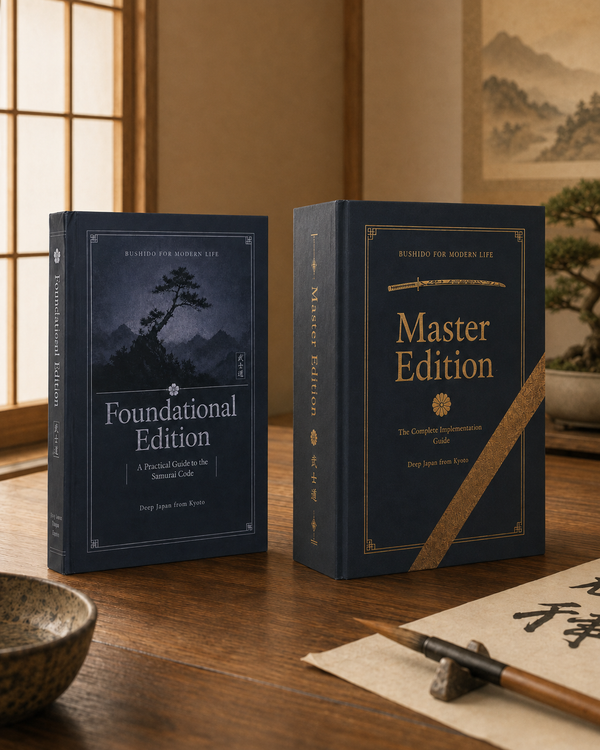
Our book, Bushido for Modern Life: Foundational Edition, interprets chivalry in relation to faith and social order, and Bushido in relation to one's role and responsibilities to others. This article adopts that comparative perspective. Rather than reducing the entire history of both traditions to a single contrast, it offers a way for modern readers to think about their own conduct.
The purpose of the comparison is not to rank one ethical tradition above the other. It is to ask how you take on your role and use your strength for the people around you. Loyalty and honor provide a way to make that question more concrete.
1. Common Ground: Those with Strength Must Govern Themselves
The book identifies a shared concern in Bushido and chivalry: accepting responsibility for how strength is used.
Having ability or authority is different from using it appropriately. Without control over your emotions, you may use your power to intimidate others. Relying solely on the strength of your position can also cause you to overlook concerns people cannot voice or information you need to make a sound decision.
1-1. Self-Control: Do Not Turn Emotion Directly into Action
You do not need to regard feeling anger or fear as a failure. Self-control is tested by what you do in response to those feelings.
Suppose there is a problem with a report submitted by someone you supervise. Angrily criticizing them in front of others will affect your relationship and the information you receive differently from checking what happened and asking for a correction. Having the authority to address the problem brings a responsibility to choose your words and setting carefully.
The book identifies the discipline of governing emotions and impulses as common ground between Bushido and chivalry. In Bushido, it also explains this through Kokki, or self-control. Even if you know how you should act, your standards cannot guide you if anger or self-preservation takes over your judgment. Self-control provides a foundation for putting the principles you understand into practice.
1-2. Service: Connect Strength with Responsibility to Others
In the book's comparison, both traditions emphasize relationships with lords, peers, and those in one's care. The question extends beyond how you demonstrate strength to whom you support through it.
Applied to modern work, this perspective can illuminate the difference between an experienced person keeping knowledge to themselves and sharing it to help others make decisions. For a manager, responsibility includes creating the conditions people need to do their work, as well as giving instructions.
When you see strength as a way to demonstrate your superiority, you treat others as people who should obey you. When you see it as a responsibility that comes with your role, you also begin to consider what they need.

2. Differences: The Order Behind Duty and Responsibility within Relationships
Even when virtues overlap, the way a code of conduct is understood depends on what its explanation emphasizes.
Bushido for Modern Life: Foundational Edition examines chivalry through its Christian framework, courtly culture, and rituals of lord–retainer relationships. In its discussion of Bushido, it acknowledges multiple intellectual traditions while emphasizing self-discipline in everyday work and relationships.
The table below summarizes the focus of the book's treatment of each tradition.
|
Bushido |
Chivalry |
|
|---|---|---|
|
Foundations of duty |
Confucian, Buddhist, Shinto, and other influences, along with role-based responsibility |
Christian faith and social order |
|
Relationships relevant to loyalty |
Responsibly supporting the relationships and roles one has accepted |
Relationships with lords and peers, and duties attached to one's position |
|
Settings in which honor is expressed |
Everyday work and conduct when others are not watching |
Courtly culture and formal social conduct |
|
Treatment of others |
Maintaining relationships and enabling cooperation through Rei and Jin |
Fulfilling obligations to others within a social order |
These are not characteristics found exclusively in one tradition. The table does not mean that chivalry lacked inner self-control or that Bushido lacked faith and ritual.
2-1. Duty: Turn the Expectations of Your Role into Concrete Action
Reading chivalry in relation to faith and social order brings forward the question of what duties accompany your position. Reading Bushido through responsibility for one's role directs attention to how those duties are fulfilled within actual relationships.
Both questions are useful for modern readers. Identify what your position or contract requires of you. Then consider what you should do in the situation before you to fulfill that commitment.
For example, accepting a role in supporting a team does not necessarily mean agreeing with every decision. Pointing out an oversight or proposing changes to an unrealistic plan can also be a way to fulfill your role.
2-2. Honor: When Others Are Watching and When They Are Not
In its discussion of chivalry, the book focuses on formal social conduct. In its discussion of Bushido, it also emphasizes maintaining standards when no one is watching.
From this perspective, honor concerns more than the moments when others evaluate you. Do you prepare documents carefully even when they will not be checked? Do you point out a mistake the other person has not noticed? Do you show the same respect to someone who offers you no personal advantage? Small, everyday choices reveal the standards you uphold.
Other people's assessments can help you reflect on your conduct. But placing too much emphasis on looking good can lead you to avoid necessary reports or corrections. Reputation and the quality of your conduct need to be examined separately.
2-3. Rei: Express Respect through Actions That Preserve Relationships
The book explains Rei as a practice that reduces interpersonal friction and allows cooperation to continue.
Respect for others is not limited to moments of agreement. Listen to an opposing view through to the end. Distinguish the person's character from the judgment that needs to be corrected. When pointing out an error, explain it in a way the person can act on. These actions create room for discussion to continue even when opinions differ.
If Chugi asks about responsibility within relationships, and Makoto asks whether words and actions align, Rei concerns how you convey that responsibility and candor to another person.

3. Applying the Comparison at Work: Bushido's Practice and Chivalry's Duty
Comparing Bushido and chivalry can help you reconsider your position and conduct at work. Acting appropriately for your role, keeping promises, and supporting your colleagues all have value. Yet even when you recognize that value, it can be difficult to decide what takes priority in a particular situation.
Applied to modern work, this comparison offers two questions. From Bushido: “What should I do for the person in front of me?” From chivalry: “Having accepted this position, how should I conduct myself?”
Duty and practice are, of course, concerns shared by both traditions. Here, the points emphasized in their respective explanations serve as two perspectives for examining your own judgment.
3-1. Turn Awareness of Your Role into Responsible Action
Titles and codes of conduct tell you what is expected of you. Considering how to meet those expectations in everyday work connects a code with concrete decisions.
-
The Bushido perspective: Put duty into action. Make necessary reports. Raise concerns that are difficult to voice. Treat people in weaker positions with respect. Fulfill the responsibilities you have accepted through your response to the situation before you.
-
The chivalry perspective: Identify the duties that accompany your position. What should you protect as a leader? What promises have you made to colleagues or customers? Consider the responsibilities that come with the authority you have been given.
Bushido for Modern Life: Foundational Edition describes loyalty as follows:
Its essence is taking responsibility for the relationships and roles you have chosen to accept.
From Chapter 1 of Bushido for Modern Life: Foundational Edition.
Makoto is not measured by having a “pure heart,” but by whether you do what you said you would do.
The book also uses conduct as the standard for Makoto:
Makoto is not measured by having a “pure heart,” but by whether you do what you said you would do.
From Chapter 1 of Bushido for Modern Life: Foundational Edition.
Awareness of your role and actions that honor your words work together. They turn responsibility from an abstract intention into responses that others can recognize.
3-2. Everyday Scenarios: Choose Your Next Action through Two Perspectives
The following hypothetical examples apply these comparative perspectives to modern work.
Scenario A: You Notice That a Team Plan Has a Hidden Disadvantage for the Customer
-
The Bushido perspective: Accept responsibility for raising the concern. Use Gi to guide your judgment and Yu to voice the problem. With Rei, explain the missing information and its effect on the customer, and propose a correction. Express loyalty to the team through action that helps resolve the problem.
-
The chivalry perspective: Review the promises you need to keep. Alongside your duties as a team member, consider what you have promised the customer. Look beyond your relationship with your supervisor and identify the fairness and responsibility your position requires.
Scenario B: Your Own Error in Judgment Makes It Impossible to Meet a Promised Deadline
-
The Bushido perspective: Communicate the facts with Makoto and carry out your response. Explain the cause of the delay, its effects, and the outlook for correcting it. Set a deadline for clarifying what remains unknown, and follow through on subsequent updates. Rather than focusing solely on explanations that preserve your honor, continue taking actions that honor your words.
-
The chivalry perspective: Consider how to take responsibility appropriately for your position. Recognize the weight of the promise you made when entrusted with the work. Look beyond your own reputation to your obligations toward the person awaiting your report and those making plans based on it.
In either situation, identifying the duties of your position does not complete the response. You also need to decide to whom, and how, you will fulfill those duties. Comparing chivalry and Bushido provides an opportunity to reconsider both questions.
4. Conclusion: Bring Your Code of Conduct Back to Everyday Choices
Comparing Bushido and chivalry offers a way to consider both the duties your position requires and the responsibilities you fulfill within relationships. Knowing how someone in your position should conduct themselves is a starting point. You then need to decide which standards to uphold when voicing an objection, reporting a mistake, or doing work no one will see.
Understand loyalty as responsibility you have accepted. When considering honor, distinguish other people's assessments from the quality of your conduct. Through Makoto, bring your words and actions into closer alignment. These perspectives connect warrior ethics with the actions you take in modern life.
When you face a difficult decision, write down what you have promised and to whom, what you will communicate next, and what you will do. The purpose is to turn an abstract virtue into a specific action you accept responsibility for taking.

Understand Bushido's Virtues through Their Connections
In Bushido for Modern Life: Foundational Edition, the loyalty and integrity discussed here are presented as interconnected with righteousness, courage, benevolence, respect, honor, and self-control.
How do you put what you believe is right into practice? How do you engage with someone whose opinion conflicts with yours? What should you prioritize to fulfill your role? Reading the virtues in relation to one another allows you to examine a decision from several directions.
-
A complete, interconnected system comprising the seven core virtues—Gi (righteousness), Yu (courage), Jin (benevolence), Rei (respect), Makoto (integrity), Meiyo (honor), and Chugi (loyalty)—and the essential discipline of Kokki (self-control).
-
Detailed historical examples of people demonstrating virtue under extreme pressure, from the swordsman Miyamoto Musashi and the warlord Oda Nobunaga to peasant heroes such as Sakura Sogoro.
-
Concrete frameworks for replacing choice overload and decision fatigue with unwavering personal standards.
Whether you are leading a business through a critical moment, navigating a life transition, or simply seeking a steady ethical compass, discover a timeless system that turns inner calm into purposeful strength.
👉 Get Your Copy of Bushido for Modern Life at Deep Japan from Kyoto