When you picture a samurai, armor and a sword may come to mind first. Yet protective equipment was not the whole story. Over their armor, warriors could wear another distinctive garment: the jinbaori, or surcoat.
Why add another layer over armor? And why give that layer vivid colors, striking patterns, and carefully considered details?
Surviving jinbaori offer a way to approach the samurai world through clothing rather than weapons alone. Looking closely at them reveals a history of practical needs and visual expression—and raises an interesting question for the present: how might the beauty of a historical garment find a place in a contemporary wardrobe?

What Is a Jinbaori?
A jinbaori is an outer garment worn over samurai armor. It provided protection against the weather while also serving as a visible expression of status.
Its use is traced to the late Muromachi period. Early examples included garments with sleeves, although sleeveless forms later became more common. The name therefore describes a clothing tradition with variations, rather than one unchanging shape.
The distinction between armor and the garment worn over it matters. To appreciate a jinbaori, we need to look beyond the equipment beneath it and consider the clothing itself: the outline of the collar, the expanse of the back, the fall of the hem, and the character of the cloth.
These details invite a different kind of attention. Instead of asking only how a warrior was protected, we can begin to ask how the complete figure was presented.
Color, Pattern, and Presence
Eye-catching fabrics and embroidery helped jinbaori communicate status as well as fulfill practical needs.
But calling them “luxurious garments” is only a starting point. It tells us little about how an individual piece works visually.
Where is its strongest color placed? Does one large motif command the back, or does the design reward a closer inspection of small details? What becomes visible first, and what emerges only when we look again?
These are useful questions whether we are studying historical dress or choosing clothing today.
A pattern alone cannot tell us everything about its owner's personality or beliefs. What we can do is observe the object carefully, without assuming that all samurai clothing expressed the same taste.
Two surviving jinbaori make that variety especially clear.
Two Garments, Two Different Impressions
Date Masamune: Black and Scarlet
Sendai City Museum holds a jinbaori used by Date Masamune, dated to the sixteenth–seventeenth centuries. Black wool is accented with gold and silver braid and a scarlet zigzag hem. Traces at the collar suggest it once carried pleated decoration resembling a European-style ruff.
The contrast invites attention: dark cloth, a sharply defined red edge, and linear highlights. It suggests that presence does not depend on filling every surface with ornament. The collar also offers a glimpse of cross-cultural influence within Japanese warrior dress.

Scarlet Wool and Crossed Scythes
A sixteenth-century jinbaori in the Tokyo National Museum takes a different approach. Dating to the Azuchi-Momoyama period, it features a pair of crossed scythes against a vivid scarlet wool ground.
Here, the relationship between the broad red surface and the large motif creates an immediate impression. We notice the composition before searching for smaller details.
Viewed alongside Masamune's garment, it encourages us to look beyond a single idea of “samurai style.” Restraint and boldness are not competing explanations of the past. Different garments offer different ways of seeing it.

Beyond the Sengoku Era: Beauty Inside and Out
The story continues beyond the age of the warring states. The Metropolitan Museum of Art holds a jinbaori dated to around 1866. An attached label identifies it as belonging to Tokugawa Yoshinobu, Japan's last shogun.
A black velvet Tokugawa crest marks the back, while silk brocade depicting flowers, dragons, and phoenixes covers the lining and lapels.
This example invites us to look inside as well as outside. A garment can offer one impression at a distance and another when opened or examined closely. Discovering that difference remains one of the pleasures of looking at clothes.
【画像挿入④:メトロポリタン美術館所蔵の1866年頃の陣羽織。表側と裏地の違いが分かる写真を配置】
Kyoto and Nishijin: The Story of the Cloth
Looking beyond the shape of a garment brings us to the material from which it is made—and to another history, that of weaving in Kyoto.
The name Nishijin comes from the western army's encampment during the Ōnin War of 1467–1477. After the conflict, weavers who had dispersed returned to Kyoto and resumed their work around the former camp. The area became known as Nishijin, the “western camp.”
Alongside the memory of conflict, there is something worth pausing over here: people returned and began weaving again. A place can carry its history not only through monuments, but through the work that continues there.
Nishijin-ori is the collective name for yarn-dyed figured textiles produced in Kyoto's Nishijin weaving tradition. Colors are introduced into the yarn before weaving, and patterns are formed through the weave.
Behind the finished cloth are stages of design, planning the woven structure, dyeing and preparing yarn, and weaving. A visible pattern depends not simply on choosing colors, but on determining how threads will come together.
Knowing this changes the way we might look at a textile. The pattern is no longer only an image. It also invites us to notice the threads and structure that make the image possible.
The history of jinbaori and the history of Nishijin-ori are not identical. One names a type of garment; the other names a textile tradition. Bringing them together today is a contemporary interpretation—not a claim to reproduce the fabric or clothing of a particular historical warrior.
THE HAORI: Bringing History into the Present
Reproducing an old garment is not the only way to engage with it. Its proportions, details, and materials can also become the starting point for something made for life today.
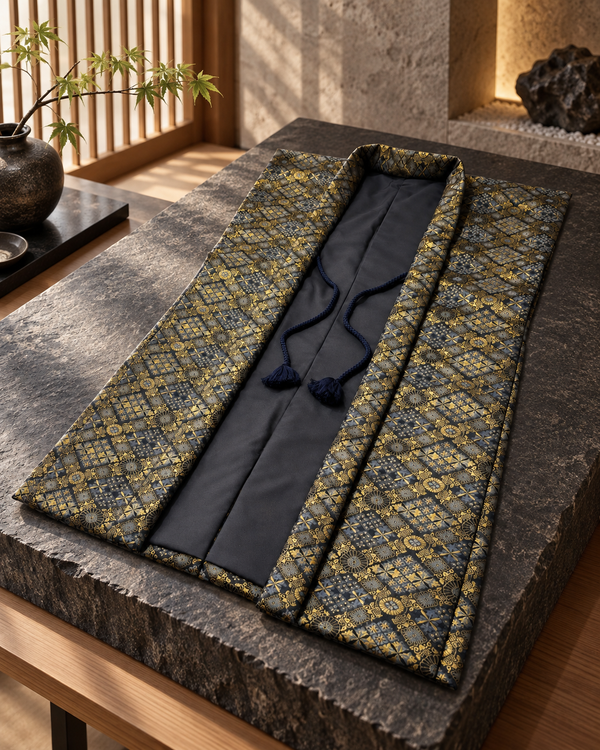
THE HAORI by Deep Japan from KYOTO brings together a jinbaori-inspired silhouette and Nishijin-ori textile in a contemporary fashion piece.
Its sleeveless construction, extended shoulder line, and long body create a distinctive outline. Dark navy cords fasten at the front, while a slit opens at the back hem. Across this shape, intricate gold-toned woven motifs give the textile its character.
The rest of the outfit can remain simple. A plain T-shirt and relaxed black trousers provide a quiet setting for the cloth's color and texture. A shirt or a fine-gauge knit offers another way to wear it, without the need to recreate an entire historical ensemble.
The intention is not to become someone from the past. It is to let an understanding of the past deepen the experience of what we wear now.
Looking at a jinbaori in a museum and wearing a contemporary piece are different experiences. Yet what we learn from the first can enrich the second: an awareness of proportion, a closer look at pattern, or a moment spent noticing how a textile responds to light.
THE HAORI invites that attention into everyday dress.

THE HAORI
by Deep Japan from KYOTO
A jinbaori-inspired silhouette. Nishijin-ori textile. A place in the contemporary wardrobe.